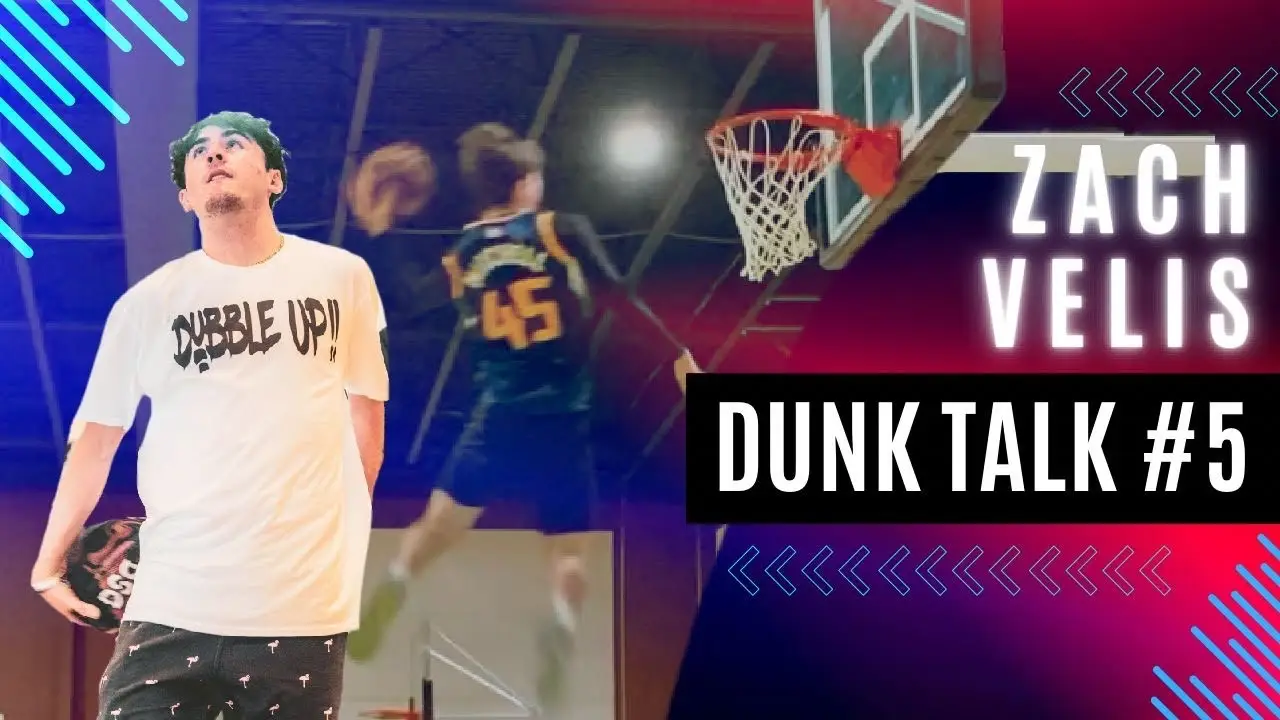
Zach Velis
Jumped over 41 inches before a rare knee injury, surgery, and a long road back. He talked through the comeback and what it taught him.
About Zach Velis
Zach Velis is a dunker from Northern Virginia who was nineteen when he recorded episode 5 of Dunk Talk. He got his first dunk at fifteen, was dunking consistently by sixteen, and has been a two-foot jumper ever since the second one. He built his Instagram as a private archive of every milestone he had hit, and only then found the community. Jonathan Clark was the first professional dunker he came across, and Clark is how he learned Dunk Camp existed. He was also one of the first dunkers Dylan Haugen ever talked to, and because they share a plant, Dylan studied his clips while learning.
The summer of 2022 was his peak. He hit his first Eastbay at sixteen on a nine foot nine rim, then a between the legs off the dribble on ten feet a week or two later. That year brought an off-the-wall Eastbay, an off-one Eastbay, the elbow dunk, a 360 Eastbay, Eastbays over people and off the backboard, and a 360 scoop finished right-handed even though he is left-handed. He was getting rec league in-game dunks too, including a two-hander he hung on and topped with a tap of his own head.
The injury happened about two days before Dunk Camp 2022 started. He was on an eight foot rim at roughly ten percent effort, did a between the legs, landed with his right knee twisted and felt a sharp pain. He went anyway, sat out the first days, took Advil and tested a 35, well below where he had been; his goal that summer had been to become the youngest person ever to win the ten foot contest. He competed regardless, hitting a tomahawk off a side lob from Jordan Kilganon and a two-handed windmill on his third try.
Two specialists called it patellar tendonitis, and so did nearly everyone he knew. For close to two years he cycled through isometrics, slow strength work and long rehab blocks, and none of it held. What convinced him otherwise was precise: he could reach zero out of ten pain during the isometrics, then jump and have it hurt exactly as much as the day he did it. The pain also felt bony rather than soft. A third doctor, one who works with the Washington Commanders and George Mason Athletics, showed him the imaging. His tendon, meniscus and cartilage were completely intact, but a leftover fragment of bone from Osgood-Schlatter as a kid appeared to have shifted in that landing. Surgeons split the tendon, removed the fragment and closed it.
He recorded the episode a week later, on the day he started physical therapy, unable to bend the leg and expecting about six months of rehab. He had said almost nothing publicly, partly because the answer he kept getting was tendonitis and partly because people told him he was not healing because he was not doing his isometrics. As he put it, nobody knows how hard he is working behind closed doors. Watching Jordan Southerland and Isaiah Rivera at camp is what made the gap between good and professional real to him. His goals, in order: rehab, then basketball recreationally, then dunking again.
On Dunk Talk