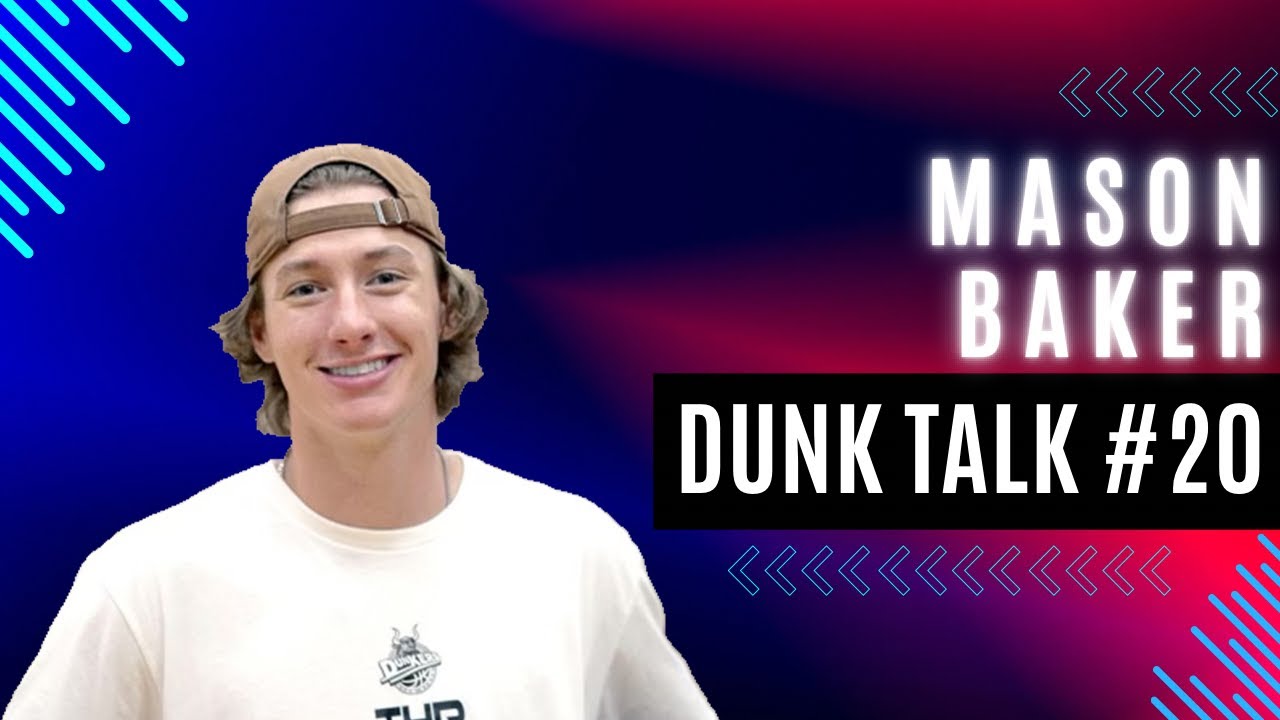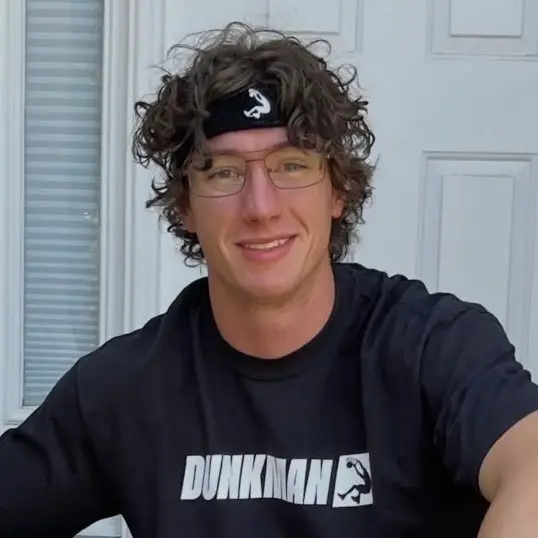
Mason Baker
A pro dunker who walked through the path that took him from amateur to the professional dunk scene.
About Mason Baker
Mason Baker did not grow up planning to dunk. He played competitive soccer as a keeper until he broke his left arm, and since he was already around 6’1″ in eighth grade, basketball looked like the obvious replacement. He did not score a single point in freshman tryouts and then played about six minutes a game. What he did have was warm-ups: if he was not getting into games, dunking before tip-off was the only way to be seen. His first dunk came just before he turned 16.
Two things turned that into a pursuit. The first was proximity: he went to high school with Isaiah Rivera‘s brother, who passed along pointers and pointed him at the videos behind his senior-year goal of hitting an Eastbay, a goal he missed. The second was a stranger: halfway through his sophomore year of college in a small Utah town, a dunker he had never met walked up on campus and asked if he wanted a dunk session. Mason had to ask what that was. It became a weekly gathering of nearly twelve guys, then a school club called the USU Dunk Squad, and once Hyrum Fechser and other non-students started showing up, the Utah Dunkers.
Lifting came late. He did not train legs seriously until that same year, when John Evans gave the group free access to the THP program, and at first he could not squat his own bodyweight for reps. The first contest he ever entered, an All-Star Weekend event in Utah, he won, judged by Jordan Kilganon, Jonathan Clark, Jordan Southerland and Isaiah Rivera. He is equally plain about the other side: three straight contests collapsed on him, and he set up the session where Tyler Currie hit a between-the-legs behind-the-back with Billy Doran, then missed it for a last-second commercial shoot.
His dunk package is built around cuffing. He has small hands, so he cuffs everything, scorpions included, and hits nearly all of his hardest dunks off the dribble rather than off a lob. He studies opposite-plant dunkers by screen recording their clips and watching them flipped. He invented a dunk he named the Butterfly Effect, and his listed signature is the 360 underboth.
He has thought about rim height more than most. He dunks weekly at 9’10.5″ because the only other hoops in his gym sit at 10’1.5″ and 10’2″, and he makes no apologies for it, but he holds a hard line: no new dunk and no Black Band unless it goes down on a true ten-foot rim. That standard cost him. He completed all five Black Band dunks in one session, closing with an underboth two hours in after about six attempts at it, then drove home annoyed rather than thrilled because the rim measured 9’9.5″ and he had believed it was 9’11”.
His clearest lesson came from losing. He felt the Dunk Camp 2024 contest was his to lose, lost it to Finn Addy, and now says that loss will do more for him than the win would have. Southerland texted him afterward that he was not next up, he was up now. The goal since has been simple: become the sixth person to complete the Black Band on ten feet, stop burning energy chasing events, and fall back in love with the journey, which he has noticed is also when he dunks best.
On Dunk Talk