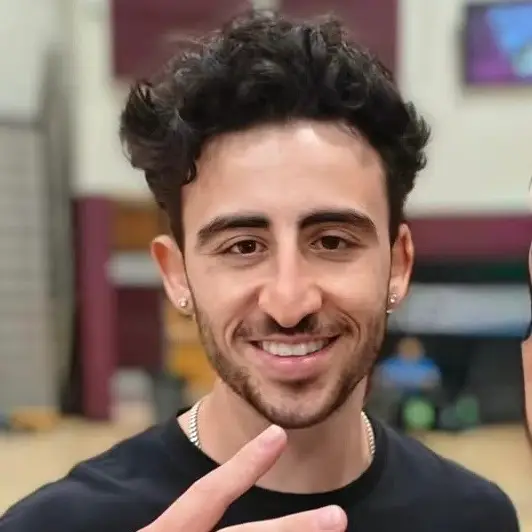
Jordan Pimstone
A dunker and coach who tested a 45” vertical and built the training system behind his brother Ethan’s rapid rise. He’s known for a smart, low-fatigue approach to jumping.
About Jordan Pimstone
Jordan Pimstone grew up in Los Angeles playing basketball, soccer and baseball, but basketball was the one; he would be on the court next to his soccer field until the second the game started. He fell for the Clippers in 2011 because of Lob City and has the tattoo to prove it. He and his younger brother Ethan Pimstone stacked pillows and jumped over them, jumped over tables, and hunted doorways. His high school was one of the top programs in the state and he never played varsity: jumper’s knee, which he did not know was jumper’s knee, took his freshman and sophomore years and came back badly enough to end his senior season.
He took a gap year with no school and trained three times a day, the Kobe route, then went to community college to play. That season broke his relationship with basketball: four-hour practices, shins and knees falling apart, half the roster suspended after stealing a golf cart, and a lot of predetermined decisions about who played. He showed out in the games he got and went back to the bench the next week. The school then named him male scholar athlete of the year, which he found genuinely confusing for a benchwarmer. He quit, and realized quickly that what he loved was jumping.
In 2022, at 21, he went all in with about a 38-inch vertical and a basic two-hand dunk. He had been studying strength and conditioning since he was 16, spent the first few years following the wrong people online, then worked out who was worth learning from and wrote his own program. It took him from the high 30s to a 45-inch test at Dunk Camp. He has logged every workout since 2017 in paper journals, every set, rep and exercise, which is how he could reconstruct exactly what he was training in November 2023 when he hit his first Eastbay.
He explains his periodization with a stove: turn one burner all the way up and everything else down to a simmer. Strength, then power, where hex bar jump variations tend to make him jump his highest, then an elastic phase, then a block where everything else drops to maintenance and he hammers the skill of dunking. He can only jump once a week, so that session is sacred; hardest lifts early, easier work late, so he has juice left to dunk. Learning load management is what took jumper’s knee from a constant flare-up to a non-issue.
That is the coach who spent close to two years begging his brother to let him fix his knees. When Ethan agreed, Jordan had to write strange cycles: he rehabs jumper’s knee by restoring sprinting before jumping, and Ethan wanted to sprint anyway, so the early months were rehab and sprint volume with intensity creeping back into the lifts. He tapered him into Dunk Camp with a 20 to 30 jump ceiling and told him to go have fun. When the text came that Ethan had tested 47.5, Jordan assumed the vert trainer was mismeasured. It was one of the most speechless moments of his life, and the moment he lost the title of highest jumper in the family for good.
He coaches full time and is CSCS certified, and the system he built for his brother is the spine of their program. He keeps Ethan away from true failure because his nervous system is wired so hot that pushing a back squat ends the session, a pattern Dylan Haugen compared on the episode to Donovan Hawkins, and he skips one-rep-max testing entirely because of Ethan’s heart condition. His own goals are still open: get near 50, dunk with his left, hit a behind-the-back, compete professionally. The one he leads with is the coaching one. He wants to take what he learned the slow way, mistakes included, and hand it to somebody else.
On Dunk Talk

Jordan Pimstone on a 45-Inch Vertical, Quitting Basketball for Dunking, and Logging Every Workout Since 2017
Read the episode