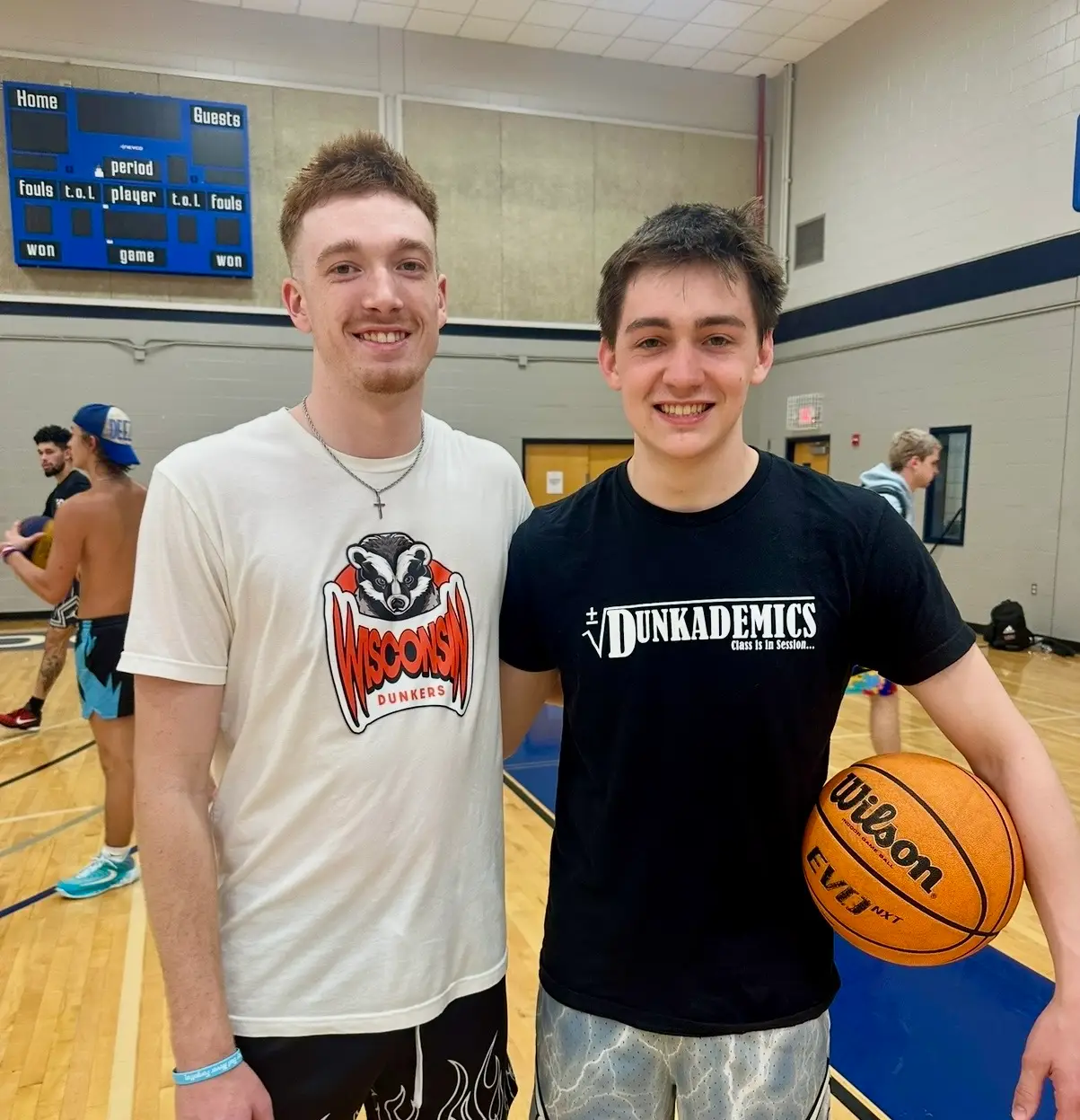
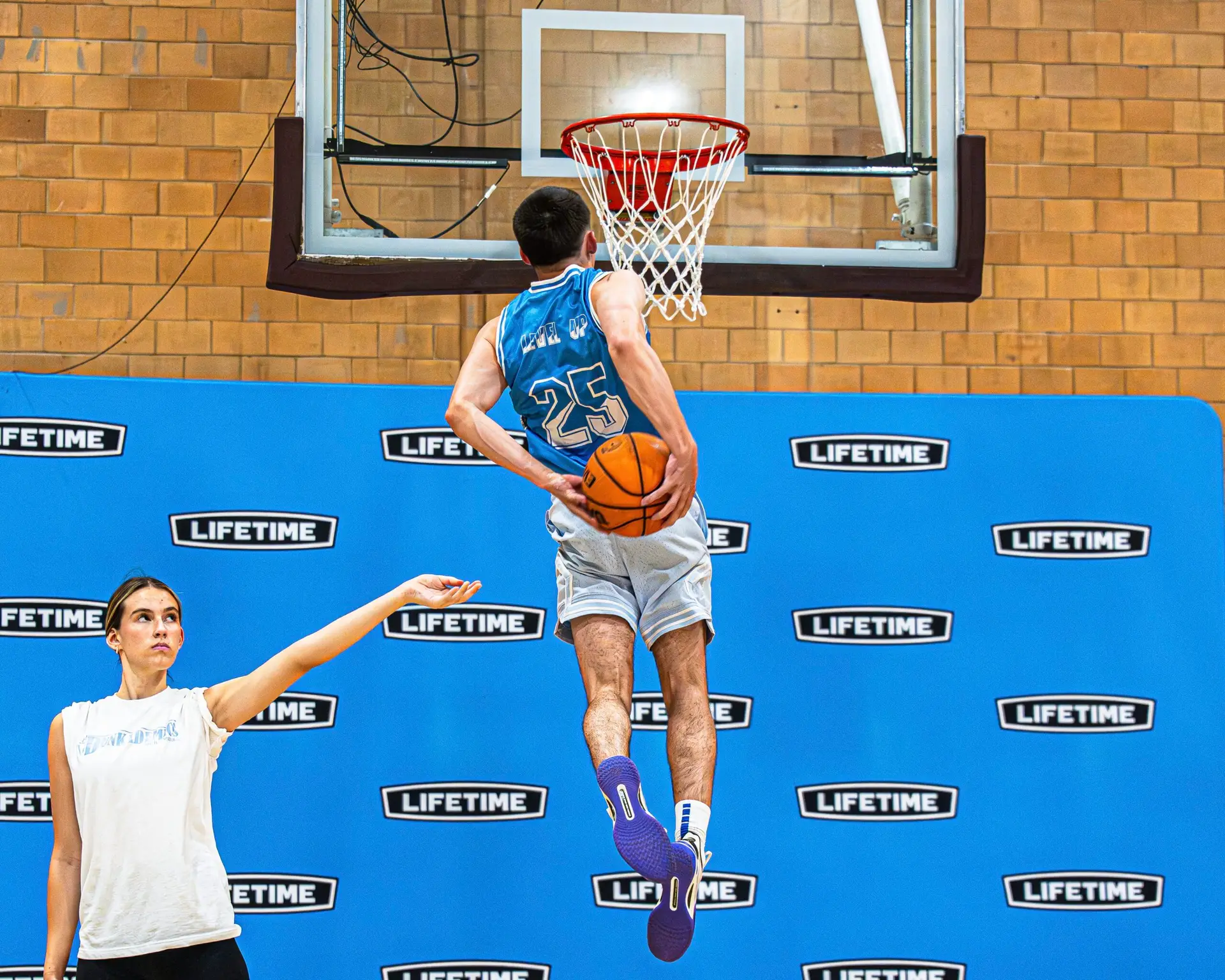
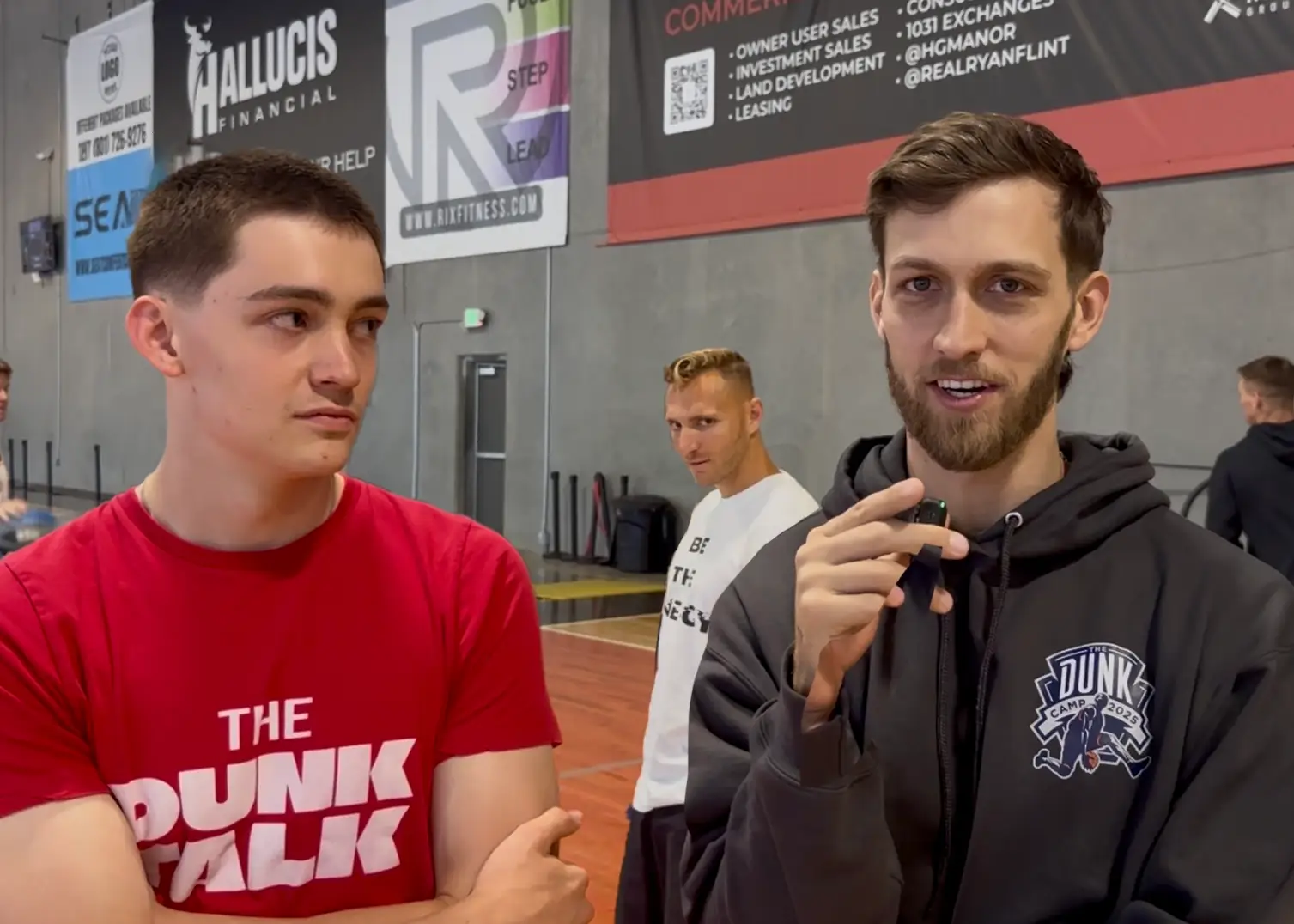
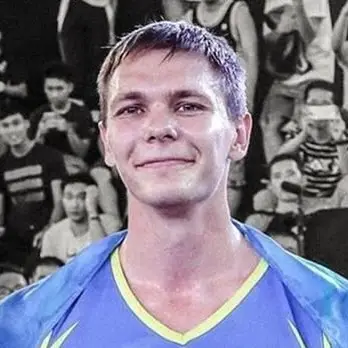
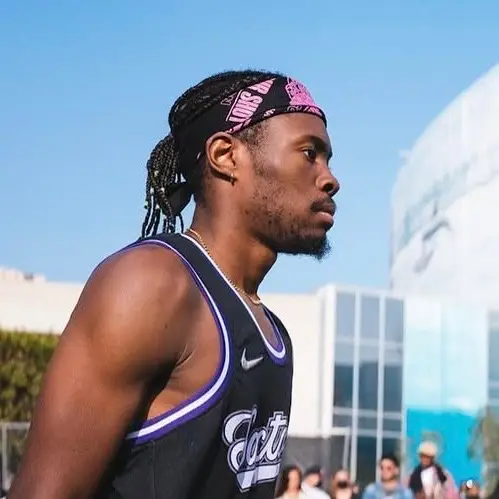
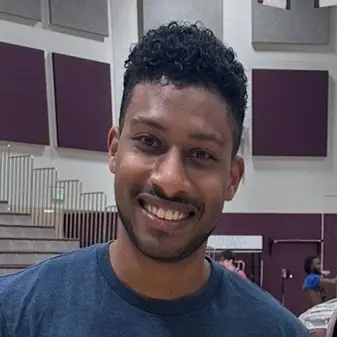
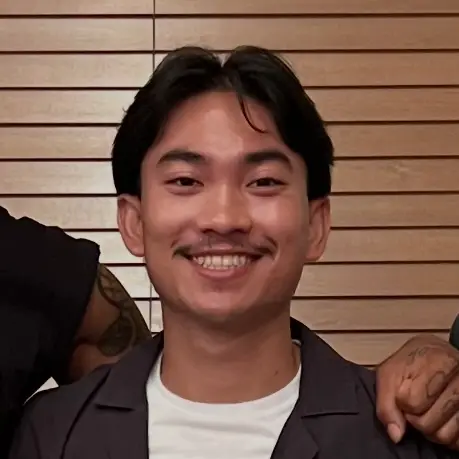
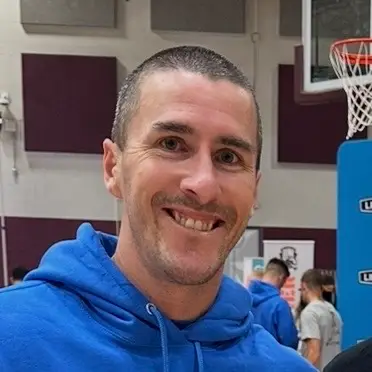
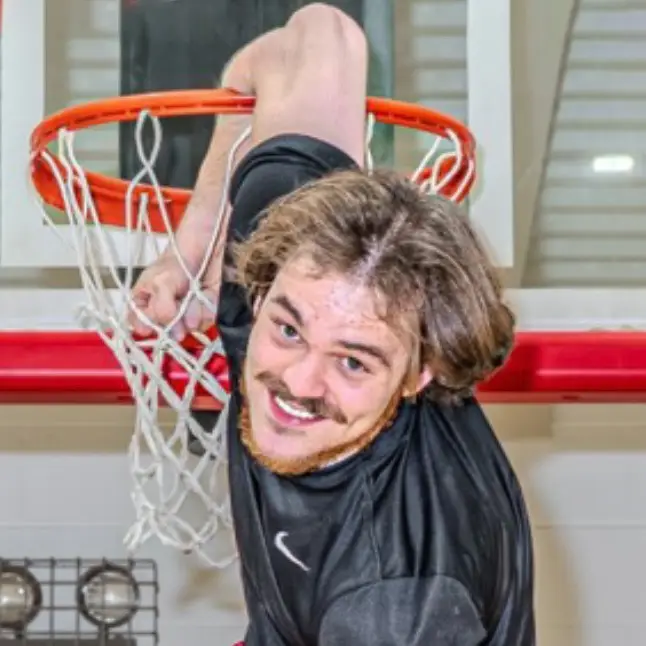
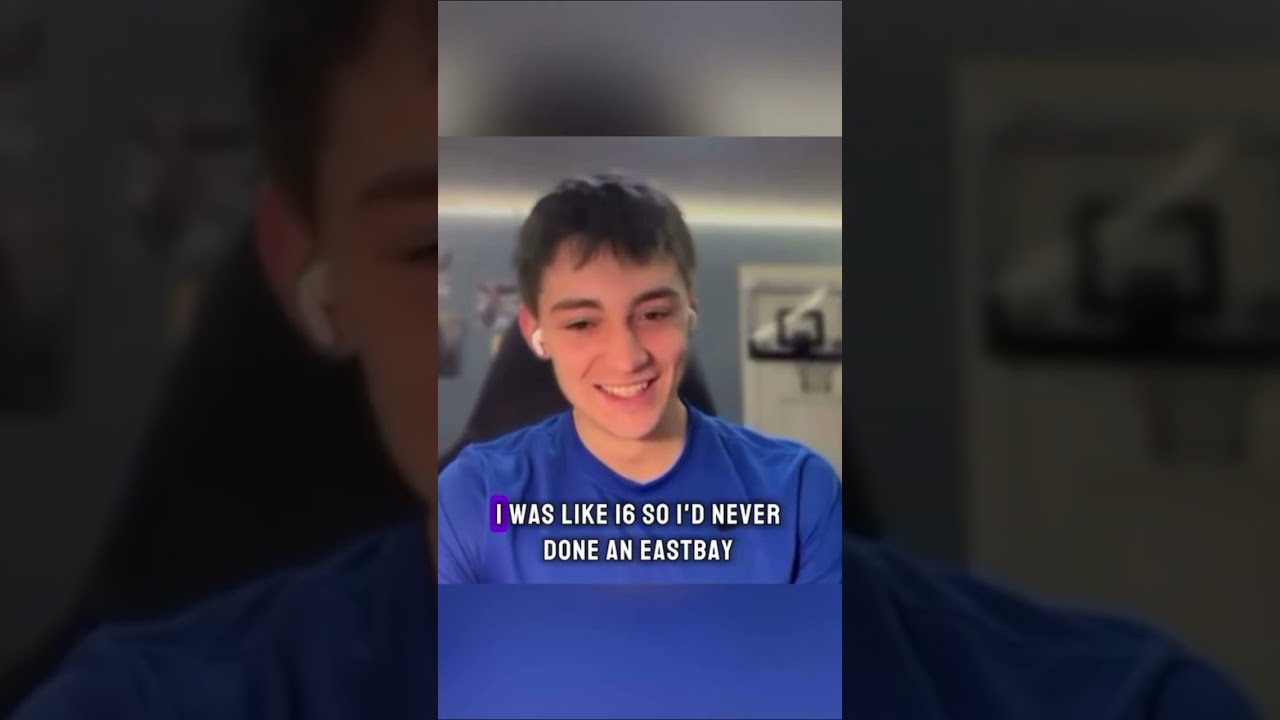
This is episode 49 of the Dunk Talk Podcast. I’m Dylan Haugen, with Hunter Castona, and the guest is Andy Behle: 5’10”, a tested 45-inch vertical, Austin, Texas, and one of the most athletically credentialed people we’ve had on the show. I met Andy at Dunk Camp 2022 and just dunked with him again at the Vegas mega-session. His story runs through Texas football, elite triple jump, a powerlifting base that will make you feel weak, two bulged discs that nearly ended everything at 19, and the smartest contest-strategy story we’ve recorded. He also has a $1,000 contest coming up that we previewed at the end.
The Texas resume
Andy is the rare guest whose pre-dunking background is conventional and absurd at once. Football from age six to eighteen in small-town Texas, where his teams reached the state semifinals or finals essentially every year and he ranked top-10 in the state at receiver and kick return. Track from 13, where he discovered triple jump after a legendary hurdles tryout (cleared the first hurdle so far he ran into the second) and rode it to a 47-48 foot jump, fifth in Texas and roughly 25th nationally as a junior; senior year he sabotaged his own distance by deciding to get swole instead.
The lifting started even earlier, because Texas football programs Olympic lifts at 12, and because his stepdad, raised military-strict and shaped by his own hard history, made every childhood punishment physical training: push-ups, pull-ups, tire flips. The resulting numbers: a 265 full clean in high school, four-plate half squats, and a powerlifting stint with a 570 sumo deadlift, 515 conventional, 415 full squat, and 255 competition bench. That’s the chassis the 45-inch vertical sits on.
The kid who hated basketball and watched Dunkademics anyway
Here’s the part that delights me: Andy never liked basketball. Didn’t watch it, didn’t play it, only 2K. But from sixth grade on, his pre-game hype ritual for football was watching Dunkademics sessions, Isaiah Rivera and especially T-Dub, in class when he wasn’t supposed to. He wanted to dunk before he had any relationship with the sport dunking comes from, which supports John Evans’ theory (quoted by Andy with the appropriate wink) that everyone obsessed with dunking is wired a little differently. His summers were lifting heavy, jumping, and trying to dunk once a week; the school year was football. He never practiced his sport to get better at his sport. He practiced flying.
First dunk around 16 (one foot, rim height unverifiable), first real one at 18: a two-foot lob catch, punched, on a known 10’. For a while he could only two-hand because, like many power jumpers, he couldn’t control the ball one-handed, until he studied Chris Staples’ power dribble and learned to swing the ball up through his off hand into the jump.
Going all in (and the dark-trap TikTok era)
The all-in moment came senior year: football ended in the state semis, a cold winter made outdoor triple jump training impossible, and Andy realized dunking was the one athletic pursuit that survives graduation; there’s no rec football, no adult track meets, but there’s a hoop in every gym in America. After graduating he trained like a triple jumper, dunked weekly, worked as a substitute teacher three days a week, and posted dunk mixes set to dark trap and Suicideboys tracks that nobody watched, until a clip of him missing a dunk went viral while he was at summer camp with no cell service. The content evolved into what he accurately calls bro-type content (“how do you dunk after deadlifting 500 pounds?” Cut to dunk. “I just jump”), and the TikTok grew to about 30k, where, he notes with comedic honesty, it has remained for three years.
The two bulged discs
The title injury happened at 19. Andy moved to Austin, went a month without a weight room, then got a gym job and tried to resume exactly where he left off: 495 deadlifts, heavy everything, same loads as before the layoff. Within the first week he bulged two discs in his back, right as his dunking was peaking (first Eastbays, consistent Windmills, elbow-in-rim height checks).
What the injury taught him is the curriculum half this podcast exists to teach: recovery is training, periodization exists because doing the same maximal thing daily guarantees diminishing returns, and getting stronger does not automatically mean jumping higher. His summary deserves framing: “squat heavy, deadlift heavy, jump once a week, you’re golden… and then you get hurt, and you realize that only works for people built different. And I’m not built different anymore.” The comeback ran through exactly the patient rebuild you’d hope, and today he’s past the 45-inch test with the back behaving, coaching others to avoid his mistake.
Bringing mom to Dunk Camp
My favorite passage of the episode: Andy’s reason for attending Dunk Camp 2022 wasn’t the training. When your pursuit is this niche, your family hears “I like to dunk” and translates it to “he plays basketball,” and the dream sounds imaginary. So Andy brought his mom and little brother to camp, rented an Airbnb, and showed her the dream was a real place with real professionals. It worked beyond the plan: his mom now follows Kilganon and Isaiah, and her favorite dunker is Jonathan Clark, because a 35-year-old teacher with a wife and kids still doing it makes the whole thing legible to a parent. (At that camp, an 18-year-old Andy also watched 14-year-old me compete in the 8’ contest, which neither of us knew would lead here.)
The contest brain
Andy’s first real contest, against his friend Dozier (the guy who hit an Underboth in an actual game), produced a strategy masterclass: he scouted Dozier’s exact three dunks, opened with the same Windmill to neutralize it, and countered the Eastbay with a double-up over four people, betting correctly that civilian judges would score them identically, a dunk he had attempted for the first time two days earlier just to confirm it was possible. It’s the same judging-arbitrage logic Donovan teaches, derived independently by a 19-year-old in Houston.
That brain gets its next test soon: a $1,000 invitational at the new Utah facility with a brutal format we previewed: a first round of three mandatory basic dunks (one-hander, Windmill, Reverse Pump) at one attempt each, then two dunks at two attempts, then finals. Andy’s assessment of his own chances is characteristically honest: the one-try round favors him because power basics are his entire identity, the later rounds favor Mason’s and Hyrum’s deeper bags, and contests are won by whoever hits. He’d bet on himself anyway, because nothing gets in his head. The full contest breakdown became its own episode, so you can find out how the prediction aged.
Goals and where to find Andy
His 2025 goals: don’t miss a single weekly session all year (consistency without injury being the one thing he’s never achieved), make the between-the-legs automatic and the behind-the-back consistent, and build toward full-time athlete status, with coaching as the engine, modeled on Isaiah’s structure. He already coaches clients through The Bounce Academy (thebounceacademy.com), an all-in-one app with training, groups, and progress tracking that even hosts other coaches’ businesses, and works only two days a week at a gym while it grows. Specialty: keeping other people’s backs from learning what his did.
Andy is “andy.bay” on Instagram and “andy.bay.bounce” on YouTube, which he’s prioritizing over TikTok, correctly, per last episode’s whole thesis. Next episode: pro dunkers break down the NBA dunk contest, with Donovan. Comment with your worst training injury and what it taught you.