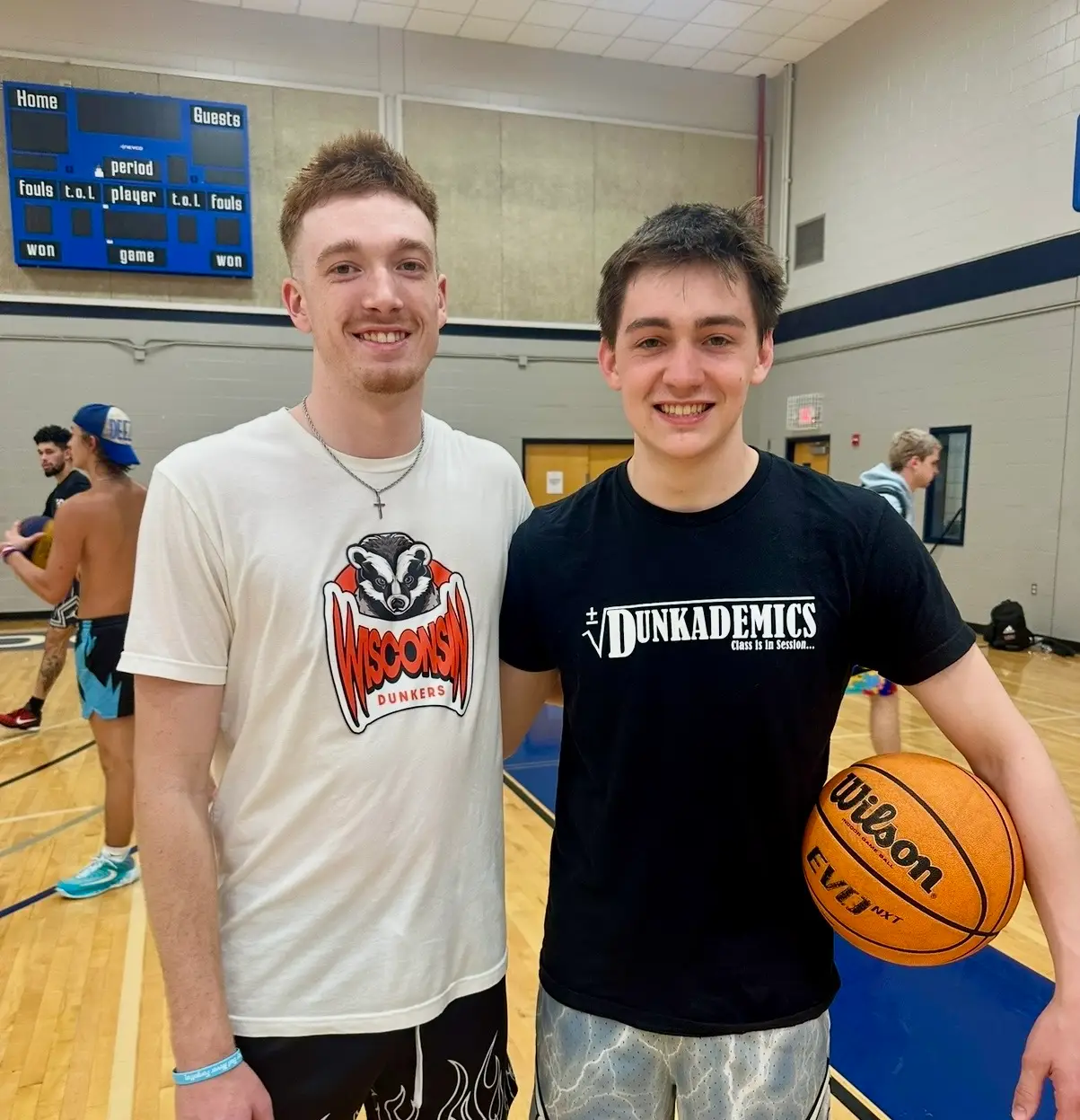
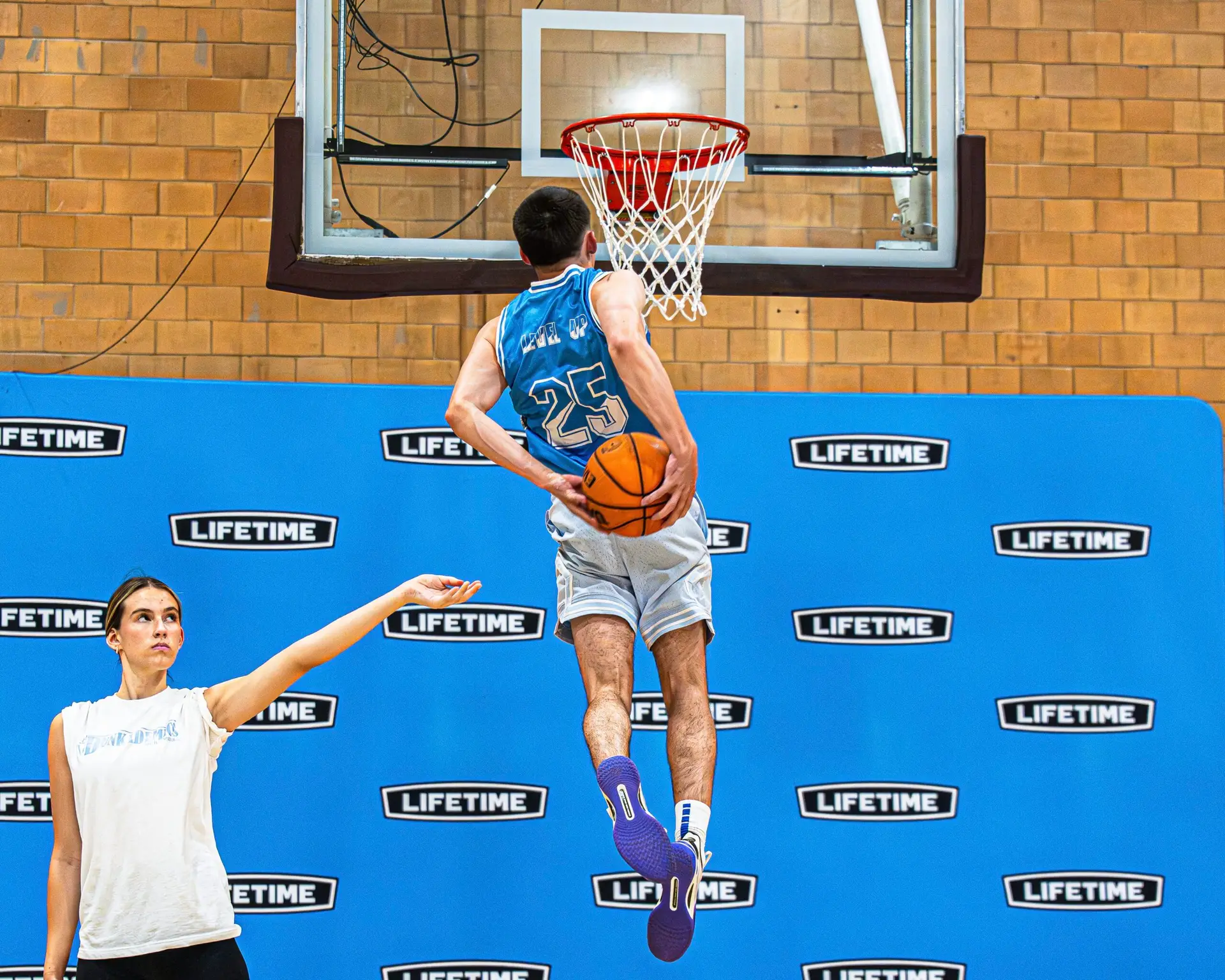
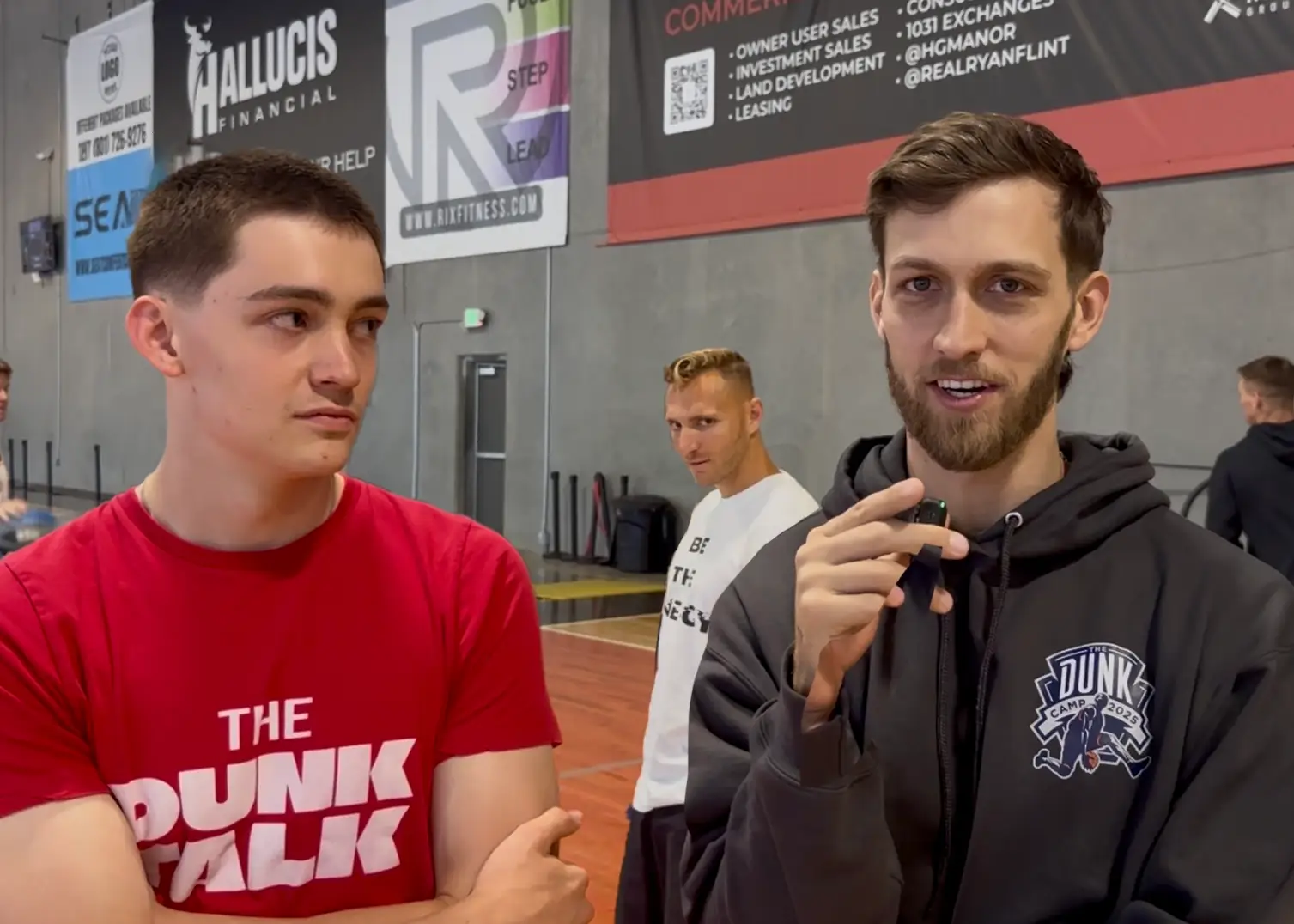
This is episode 47 of the Dunk Talk Podcast, and it’s the one the whole show has been building toward. I’m Dylan Haugen, with Hunter Castona, and the guest is Jordan Kilganon: 6’1.5”, professional basketball dunker, and by most accounts including ours the greatest dunker of all time. Half the guests on this show cite him as the reason they dunk. Isaiah’s reality broke watching the Crown dunk; Dillan saw him at Dunk League; Hyrum met him at a Vasa gym and changed his life. This is the origin story from the man himself, plus his training philosophy, his programs, and the first long-form discussion of the signature shoe that’s about to exist.
Named after Michael Jordan, dunking at age one
Kilganon was named after Michael Jordan, and his dad, a personal trainer, had him dunking on a lowered hoop at one year old, before he could meaningfully jump. The footage exists. From Fisher-Price nets onward, dunking on something was a constant of his childhood in Sudbury, Ontario, alongside literally every sport his parents offered: basketball, co-ed volleyball, softball, baseball, badminton, and a track career he summarized with brutal honesty (javelin good, high jump fine, terrible at long jump, second-last in the 400).
The pivot came around 14, when he discovered pro dunking existed: Team Flight Brothers, The Air Up There, Justin Darlington, proof that you could keep only the best part of basketball. A local kid named Pat Kingsley, the other Sudbury low-rim obsessive, introduced him to the online scene, and Kilganon started dunking on low rims three to four hours a day, every day. It rewired even his basketball: the grade-nine three-point shooter became a grade-twelve slasher because he’d stopped practicing anything but jumping.
The high school progression, for everyone who thinks he was born finished: touched rim in grade 9, grabbed rim in grade 10, first dunk in grade 11 around age 16 (a fingertip two-hander on a rim he now suspects wasn’t 10 feet), and basic one-handers and a reverse two-hand by grade 12. That’s it. That’s the GOAT at 18.
The all-in decision and the 720
After his final high school basketball game, Kilganon had the post-graduation crisis everyone has, and resolved it with one sentence: there’s one thing I love more than anything in the world, so let’s see what happens if I only do that. Dropping every endurance sport (and discovering protein) produced fast gains: Windmills and between-the-legs within a year or two, serious lifting by his second year of college, and then the moment that announced him: Hoopmixtape flew the unknown kid from Sudbury to LA and asked, almost casually, “you’re going to kill a 720, right?” He had never attempted one. He destroyed it first try, and says it’s still the best 720 he’s ever done. At the time, it had a real claim to greatest dunk ever performed.
The first paid event was St. Mary’s College, and his memory of it is perfect: being on a plane because of dunking, getting handed chicken fried rice, thinking this is the most insane thing ever. The milestones after need no introduction: Dunk League (where he went essentially miss-free through everything but How High and Dunk Horse), the 2016 NBA All-Star Scorpion in jeans that changed his life, and the Gary Payton lost-and-found video, which remains the NBA’s most-viewed video ever posted on any platform. Plus Ghetto Games, the China contests, and the Dunk Camp era, about which he said the thing I’ll remember from this episode: he wishes it existed when he was young, its existence makes the world better, and after his first camp he, a man who doesn’t journal, wrote down how the week felt because it was the best of his life. He’s going to have Cory count how many first dunks he’s assisted at camps. He celebrates them harder than the athletes do.
The training philosophy: jumping is the exercise
Kilganon’s training history is self-experimentation refined over fifteen years. The early protocol was pure frequency research on himself: jump three days straight, rest two; try five; try seven; try a month straight (verdict: too much); settle into blocks of five-on with a few rest days, hitting new heights each wave. The principles he’s kept through every era: jump often, get strong, stay elastic, train ground contact time. The thing that’s changed most with age is the injury-prevention layer, which he describes as an art: pushing as hard as possible without breaking, warmups that respond to what his body says that day rather than what the plan said last week. Watch him in a gym now and you’ll see him pause, move, listen, then choose.
His numbers, for the record: a 335-345 college deadlift he was thrilled with, three-plate squat and four-plate deadlift in the Bounce Kit era, a 505 deadlift and 365 squat during COVID, and currently a 375 squat at 15 pounds lighter than that era, with more in the tank he doesn’t bother testing because, in his words, the goal isn’t a four-plate squat, the goal is to jump higher.
The most actionable sixty seconds of the episode was his speed rule, which he programs for athletes and which I’ve personally adopted since he told me about it at Wisconsin camp: every session, take at least five jumps where you run in about 10-20 percent faster than comfortable and try to get off the ground quicker than comfortable. Most attempts will buckle; the rhythm of the chain will be off and you’ll lose three inches. Then one will click, and your body learns the timing at the new speed. It trains intent, elasticity, and coordination at once. He also pointed out why dunkers overestimate their conditioning: a lob dunk is a 90-95 percent jump, while a true Vertec max is 100 percent, which is why a session of height checks exhausts him faster than an hour of dunking.
Bounce Kit, Jump Master, Jump Master X
The program lineage, from the source: Bounce Kit was the one-time-purchase, heavily triphasic original that worked for a huge number of people. Jump Master is its refined successor, better at keeping injuries at bay, priced deliberately low (about $15 a month, less annually) because he wants it accessible. Jump Master X is the new top tier: fully custom coaching for athletes who are wildly serious, the program Ben Hopkins and Finn Addy train under, and the one Kilganon says teaches him the most because every custom athlete is a new experiment.
The shoe
The portion of this episode that will age best: Kilganon told the full story of the signature shoe in progress. He spent years buying every dunking-viable shoe with his own money (Serious Player Only, Way of Wade, Jordans, Nike, nobody was sending him anything) hunting for grip that could survive his approach speed, where even a 10-30 percent slip rate on max jumps is disqualifying. The Game One came closest. He reached out to the company, they put him in their first-ever sample of the Game One Low, he happened to be exactly their testing size, and he had to convince them he wasn’t flattering them for a sponsorship when he called it the best shoe he’d ever worn: lighter than anything comparable with grip he rates a ten out of ten, the first shoe that makes dusty courts irrelevant for a speed jumper. His own colorway arrives in days; the release has an approximate date he can’t say yet. The full launch got its own episode later: the first professional dunker with a signature shoe.
Top five dunks, goals, and the why
His own top five on 10’, freely mixing best and favorite: the Reverse 540 Scorpion (which he wants to redo), the 360 Lost and Found, the Kilganon-Away (the blind 360 Eastbay over a holder), the 360 Kamikaze, and his recent 540s, which he feels he’s finally truly mastered. The goals: an official tested 50 before he’s done, a bajillion dunks of which the big current targets are secret, growing the clothing line and new dunker products, scaling the Jump Master ecosystem, and a longevity plan that should terrify everyone: he doubts nothing about being a pro dunker at 45, and looks forward to the day dunking gets only 95 percent of him, meaning he could go five days of vacation without finding a hoop. That’s the retirement dream of the greatest of all time: slightly fewer dunks.
And the why, which explains the whole career: his dad made him feel like he could do anything, by example, and Kilganon dunks to make other people feel that. Given how many of this show’s guests started because of him, it’s working. His advice for getting into the community was characteristically simple: just reach out, don’t be shy, make friends; Travis Reynolds, sitting off-camera giving a thumbs up, built his entire connection to Kilganon by being first comment on every video until they were friends.
You already follow him, statistically, but: Jordan Kilganon, everywhere. Next episode is how social media changed the dunk game. Comment with the Kilganon dunk that broke your brain first.